
“When was the last time you were creative?” Before I started working at XCL World Academy Singapore, I had the opportunity to attend workshops delivered by music teachers from all over the world. One workshop about creativity in music education really caught my attention. It’s interesting to highlight that it’s expected for us artists to be creative, but that is not always the case. After asking us to think about some of the creative moments in our lives (from childhood to the present moment), our professor asked us the big question: “When was the last time you were creative?” I was surprised to see how many of us could not answer the question. I’d like to invite you all to reflect about this topic and think about the last time you were creative and how important it is for you.
According to the IB philosophy, students in the Primary Years Programme (PYP) are “driven by their inquiry and creativity to develop deep understandings within their learning.” It’s known that creativity involves critical thinking, planning and focusing the attention. Children learn through this process as different parts of the brain jump into action. They might discover something they never knew before, learn how to solve a problem, or figure out a new way to look at or do something. Creating a safe environment for the children where they can move, play and explore is crucial for a young child’s imagination and creativity. Giving them time to experiment on their own or in groups opens up creative and learning opportunities they might miss out on when confined to their chairs for too long.
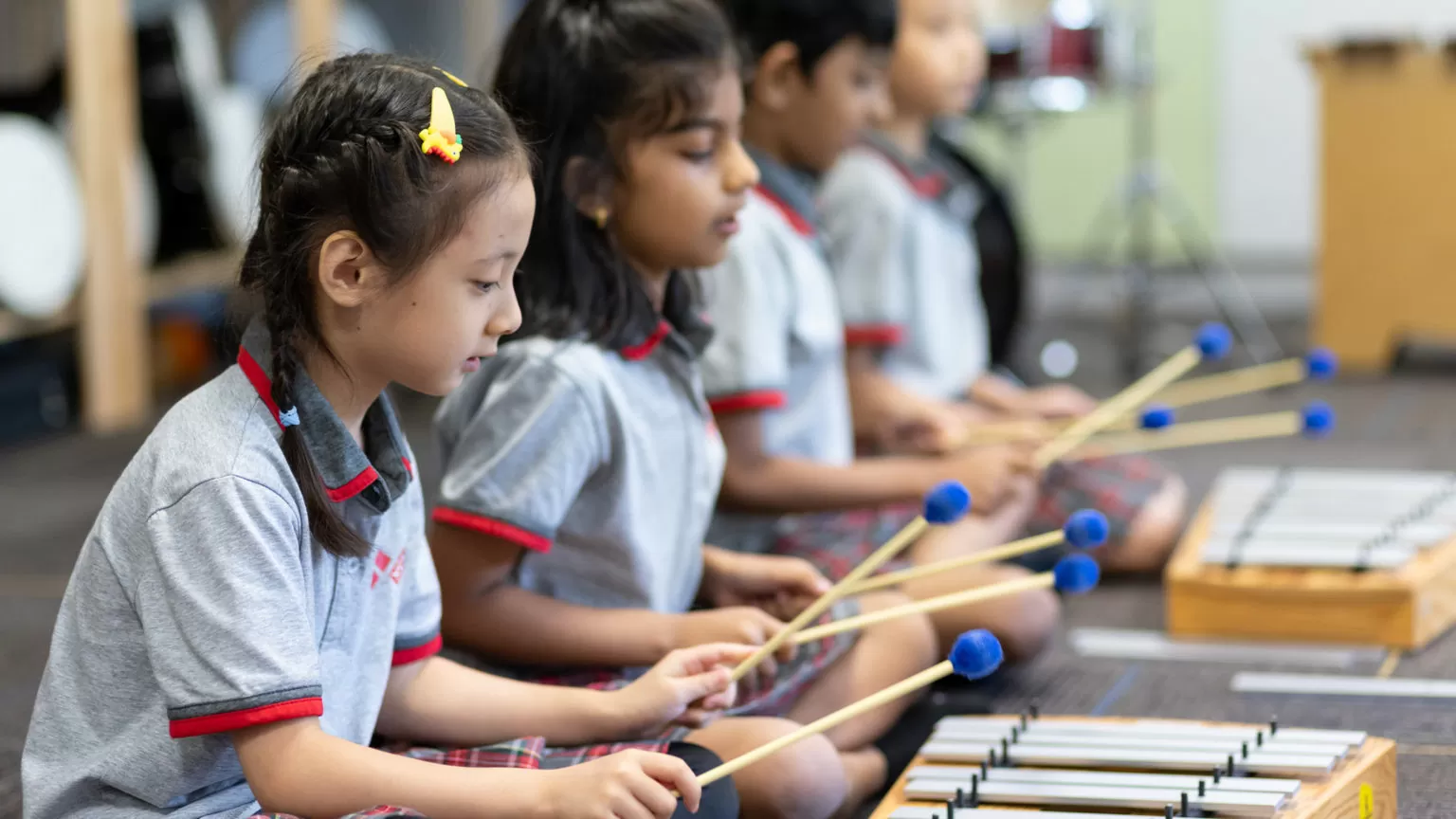
What does that mean for our students’ learning experiences? How does that happen in the music classroom for Early and Primary Years? Through the Orff methodology which was developed by the German composer Carl Orff, and has music creation by students as one of its main purposes. This approach of teaching music combines speech, movement, body percussion, folk dance, musical games and drama. Students are constantly encouraged to explore, improvise, and create something starting from the simplest ideas and going to more complex musical compositions. The methodology (https://en.wikipedia.org/wiki/Orff_Schulwerk) is a “child-centered way of learning” used by teachers to encourage their students to enjoy the process of making music. I believe we learn something by doing something, and with the arts is no different.
In EY focus is given to movement, singing and unpitched instruments whilst in PY, children are not only working on the skills mentioned above but also developing their Orff instrumental skills. We can travel to the farm, sing with the animals, cook together, dance to the ‘Old Man Mosie’ groove, play the Dr. Foster game and so much more. The sky’s the limit to our imagination. And now, I can happily assure that I’m creative every day. I’m not only creating for the students but especially with the students.