

Choosing a Kindergarten in Singapore: Local or International?
You're staring at spreadsheets, comparison charts, and school websites. Local kindergarten or international? Both paths lead to excellent education, but they take you to very different places.
Both paths can work. The right choice depends on your child's learning style, your family's future plans, and what you value most in early education.
What Parents Actually Prioritise
Before diving into programme details, let's start with what matters most to families making this decision.
According to research across Singapore's international school community, teaching approach and style tops the list at 63%. Teacher quality follows at 57%, then location convenience at 53%. Child-teacher ratios matter to 48% of parents, and value for money matters to 41%.
Academic reputation ranks lower than you'd expect at just 35%. Parents care more about how their children learn than school rankings at this age. They want nurturing teachers, age-appropriate teaching, and environments where curiosity thrives.
This tells us something important. The right kindergarten isn't necessarily the one with the biggest reputation. It's the one where the teaching philosophy matches your child's needs and your family's priorities.
Local Kindergarten in Singapore: What to Expect
Local preschools in Singapore span three main tiers, from subsidised government options to premium operators.
One thing to note first: Local preschools follow a January to December calendar, while most international schools run August to June. If you choose local kindergarten but plan to switch to international for primary, your child will finish K2 in December and enter the international school mid-year (typically January). Some families find this transition smooth; others prefer starting at an international school from Early Years to keep their child with the same cohort from day one.
MOE Kindergartens run four-hour K1 and K2 programmes for Singapore citizens and permanent residents, following the Nurturing Early Learners (NEL) framework across six learning areas. The curriculum focuses on foundational skills in both English and Mother Tongue Languages (Chinese, Malay, or Tamil), preparing children for Singapore's bilingual primary school system. Fees sit around S$160 per month with subsidies for citizens and PRs. [source: MOE.gov.sg, accessed November 2025]
Anchor Operators and ECDA-accredited centres cap kindergarten fees at S$150 per month (Anchor Operators) or range from S$100–400 per month for citizens and PRs receiving subsidies. Foreign families pay full fees without government support, typically S$800–1,200 per month at the same centres.
Premium local preschools occupy the space between subsidised options and international schools. Operators like Mindchamps, Odyssey, Pat's E-Bridge, Children's Cove, Lorna Whiston, and Brighton charge S$1,500–3,000 per month. These programmes vary in philosophy (Montessori, bilingual immersion, academic preparation) and attract foreign families seeking quality early education without committing to the full international school pathway. They compete directly with international school Early Years programmes on curriculum quality and facilities.
The bilingual policy is central to local kindergarten education. Children learn in English while building strong Mother Tongue foundations. This dual-language approach aligns with Singapore's national education system and supports integration into local primary schools.
Local kindergarten suits families who:
● Plan to enrol in Singapore primary schools
● Value strong bilingualism (English plus Mother Tongue)
● Are citizens or PRs seeking subsidised fees
● Want stable local peer groups with less turnover
● Live near highly-rated MOE or ECDA-accredited centres
The teaching approach is structured and teacher-led, with clear focus on primary school readiness.
International Kindergarten in Singapore: What to Expect
International kindergartens operate as Early Years sections within international schools. They follow global curricula including IB Primary Years Programme (PYP), Montessori, Reggio Emilia, or British Early Years Foundation Stage.
The curriculum approach centres on inquiry-based, play-led learning. Children explore concepts through hands-on discovery rather than formal instruction. The focus sits squarely on developing curiosity, creativity, and critical thinking. Learning emphasises building skills through experience rather than memorizing information.
At schools like XCL World Academy, the IB PYP framework structures this inquiry-based approach from age 3, creating seamless progression through Early Years into Primary. Children learn through exploration while building the thinking skills that will serve them throughout their education journey.
English serves as the primary language of instruction, though some international schools offer bilingual options (English-Chinese, English-French). Most provide English as Additional Language (EAL) support for children still building language confidence.
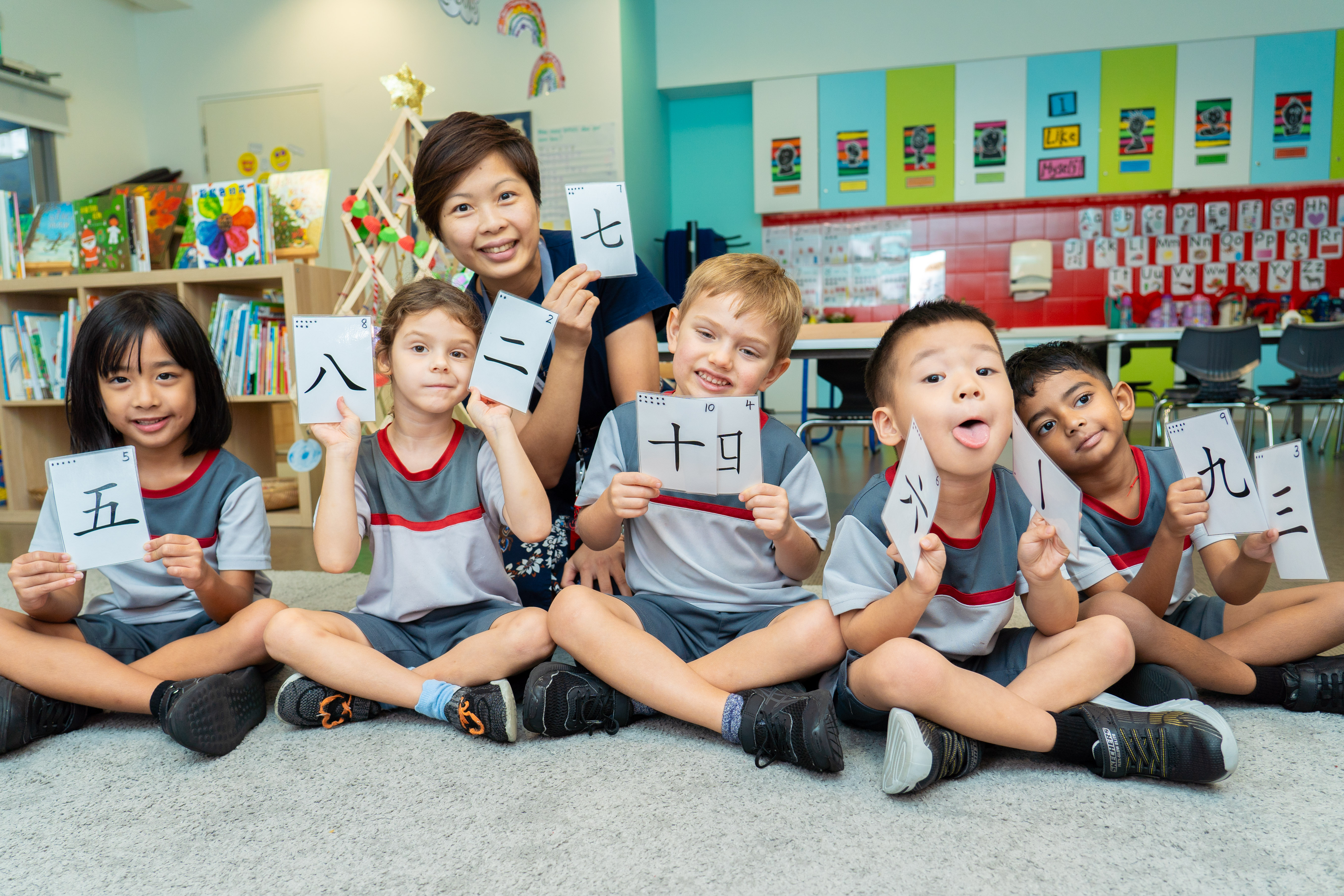
XWA’s English–Chinese Bilingual Programme provides an immersive dual-language experience, guided by two native-speaking educators in every classroom, supporting confident bilingualism from an early age.
Fees reflect the full-service international school model. Monthly costs typically range from S$800 to S$2,500 or more, varying by school positioning. Premier international schools charge at the higher end of this range, while accessible international options offer mid-range pricing without compromising on curriculum quality or learning outcomes. Subsidies remain limited for expat families, though some schools provide means-tested financial aid.
Student communities reflect high nationality diversity. At XWA Early Years, children learn alongside a community of 50+ nationalities, relocate internationally at higher rates than in local kindergartens, which introduces children early to global mobility patterns they may experience throughout their educational journey.
International kindergarten suits families who:
● Are expat families or planning international relocation
● Will continue in the international school system through primary and secondary
● Value inquiry-based, play-led learning approaches
● Want diverse, multicultural environments (multiple nationalities)
● Want integrated specialist programmes (music, arts, sports, swimming) as part of the regular curriculum
● Need curriculum continuity (IB PYP pathway leading to MYP and Diploma)
Should You Start at International Preschool or Wait Until Grade 1?
Some families consider enrolling in a local or premium preschool for the early years, then switching to international school for Grade 1. Is this a good strategy?
Starting at international preschool makes sense if:
• You're confident your child will continue in the international system through primary and secondary
• You want to avoid mid-year transitions (local K2 ends December; international Grade 1 starts August)
• Curriculum continuity matters (IB PYP runs from Early Years through Primary)
• You want your child to build friendships with classmates they'll grow up with
Waiting until Grade 1 can work if:
• You want to keep early years costs lower while your child is young
• You're still deciding between local and international pathways for primary
• Your child would benefit from a local preschool environment (bilingual immersion, neighbourhood community)
• You're comfortable with a mid-year or new-cohort transition at Grade 1
There's no wrong answer. Some children transition seamlessly at Grade 1; others benefit from the stability of one school community from age 2. Consider your family's timeline, budget, and how your child handles change.
The 5 Differences That Actually Matter
Five factors create the real distinction between local and international kindergartens:
Teaching Philosophy
Local kindergartens use structured, teacher-guided approaches with academic readiness as a clear goal. Teachers lead activities and establish routines. International kindergartens embrace inquiry-based learning where children explore topics through questions and hands-on investigation. Teachers facilitate discovery rather than direct instruction.
Language of Instruction
Local kindergartens implement bilingual education (English plus Mother Tongue Languages). International kindergartens teach in English with a variety of options for a second language. Some international schools, such as XWA, offer innovative Mandarin immersion programs.
Student Diversity and Community
Local kindergartens serve majority Singaporean citizens and permanent residents, creating stable peer groups with deep local connections. International kindergartens host families from multiple nationalities and backgrounds. Some children were born in Singapore, some have lived international lives moving from one country to another and some children are living abroad for the first time. At XWA, students from over 50 nationalities come together to form a truly global community, learning alongside peers from diverse cultural backgrounds. Families relocate internationally more frequently as career mobility brings them to and from Singapore.
Fees and Affordability
Local kindergartens cost S$100–400 per month for citizens and PRs with subsidies. Premium local preschools (Mindchamps, Odyssey, etc.) charge S$1,500–3,000 monthly. International kindergartens sit at S$800–2,500+ with limited subsidy access.
Pathway Continuity
Local kindergartens prepare children for Singapore primary schools and MOE Primary 1 registration. International kindergartens offer a seamless transition within the international school system, guiding children from the PYP through the MYP and on to the IB Diploma or Career-related Programme. With a strong focus on developing learning skills and independence, an international education equips children to thrive in any curriculum.
At schools like XWA, IB PYP in Early Years flows directly into PYP Primary, then MYP, and finally IB Diploma or Career-related Programme, creating up to 16 years of curriculum continuity.
Questions to Ask Yourself
On timeline: How long will you remain in Singapore? If your stay feels uncertain or relocation seems likely, the international curriculum offers global portability. If you're committed long-term with permanent residency plans, local pathways may offer better integration and community stability.
On learning style: Does your child thrive with clear structure and routine, or do they flourish with open-ended exploration? Local kindergartens deliver more formal academic preparation, while international schools emphasise play-based discovery and child-directed learning.
On language priorities: Is strong Mother Tongue proficiency (Chinese, Malay, or Tamil) essential to your family’s cultural identity? Local kindergartens provide bilingual immersion aligned with Singapore’s national curriculum. Some international schools also offer genuine bilingual programmes — XWA’s Early Years and Primary Years include a structured English–Chinese bilingual programme, where young learners are taught a variety of subjects in both languages by dedicated educators in an engaging, co-taught environment, helping them build confidence and fluency in speaking, listening, reading and writing from an early age. If you prefer English-focused environments with optional second languages, many international schools deliver that model.
On primary school pathway: Have you secured (or actively planned for) Primary 1 registration through MOE's registration phases? Or will you continue in the international system? Your Early Years choice should connect to your primary school strategy, as mid-stream transitions add complexity even though they remain possible.
When Local Kindergarten Makes Sense
You're likely best suited to local kindergarten if you're a Singapore citizen or permanent resident planning to use the public school system. Strong bilingualism (English plus Mother Tongue) serves as a family priority. You value structured learning and academic preparation for Primary 1. Budget considerations matter significantly. You live near highly-rated MOE or ECDA-accredited centres. You want your child embedded in a stable peer community with minimal turnover.
Local kindergartens provide excellent preparation for Singapore's primary schools, combining quality teaching, bilingual immersion, and accessible fees. The system works exceptionally well for families committed to the local education pathway.
When International Kindergarten Makes Sense
International kindergarten likely fits your family if you're an expat household or planning international relocation within a few years. You intend to continue in the international school system through primary and secondary levels. You value inquiry-based, play-led learning approaches rooted in global curricula. You want your child exposed to high cultural diversity across multiple nationalities. You need curriculum continuity, with IB PYP preparing for the MYP and Diploma pathway. English-focused instruction (with optional second languages) matches your family's needs.
International kindergartens prepare children for global academic pathways, emphasising creativity, critical thinking, and cross-cultural understanding. The model serves mobile families and those prioritising international curriculum continuity.
Some Singaporean families also choose international preschool for the early years, valuing diverse classrooms and inquiry-based learning, before transitioning to MOE primary school.
Can You Switch Later?
Transitions between local and international systems remain possible, though timing matters considerably.
Kindergarten to Primary 1 transitions vary significantly by residency status. Moving from local kindergarten to grade 1 of an international school (in Singapore) requires schools to assess readiness, but they don't require specific curriculum background. For citizens and PRs, switching from international kindergarten to local Primary 1 means securing placement through MOE's registration phases. For foreign children, MOE primary entry requires passing the AEIS exam and depends on available vacancies—many don't secure placement even with strong results. Most foreign families continue in the international system by default.
For Singapore Citizens and Permanent Residents, one of the biggest challenges can be transitioning between education systems during the primary years, particularly from Primary 3 onwards. At this stage, the MOE curriculum becomes significantly more content and knowledge intensive, with increased subject depth across all subjects and the introduction of Science, alongside higher expectations in Mother Tongue languages. By the end of Primary 4, schools assess students to determine whether they will take standard or foundation-level subjects in Primary 5 and 6, making mid-primary transitions especially complex.
For foreign children, entry into local schools via the AEIS route during the primary years is even more competitive than Primary 1, with limited vacancies at most schools.
Simplified subjects cover approximately 75% of the standard curriculum. Children switching from international schools will have missed years of Mother Tongue instruction and if placed in the simplified track, they'll continue covering less content than their local peers, making catch-up increasingly difficult.
The Right Fit Matters Most

Whether you choose local or international, the most important factor remains alignment between your child's learning style, your family's future plans, and your values around education.
For families seeking an international curriculum that delivers meaningful educational value, schools like XCL World Academy bridge an important gap. Beginning with the IB Primary Years Programme from Early Years, XWA combines global educator expertise, world-class facilities, and a diverse community representing over 60 nationalities. Students benefit from strong academic foundations alongside innovative programmes such as the English–Chinese Bilingual Programme, Little Xplorers outdoor learning, and the XCLerate Future Skills Programme. Together, these initiatives develop language proficiency, critical thinking, communication, and problem-solving skills. This balanced approach connects classroom learning to real-world contexts, ensuring children are both academically grounded and future-ready.
Ready to explore your options?
View XWA's Early Years programme or book a campus tour to see how inquiry-based learning works in practice.
The right kindergarten isn't determined by prestige or price. It's about finding the environment where your child will thrive. Start with understanding what matters most to your family, and the choice becomes clearer.

.jpg)