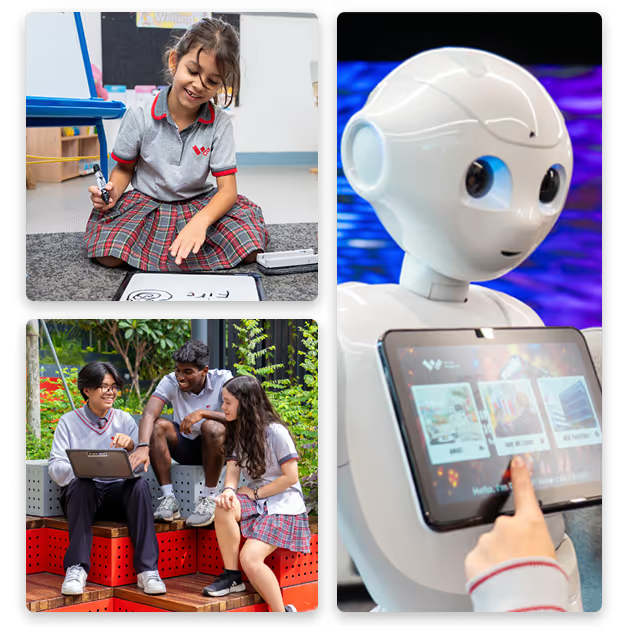

Many of us have sat in classrooms and thought, “How exactly am I going to apply this knowledge in my future life?” The way schools have worked in the past has been centred on having a teacher disseminate facts and concepts to an often uninterested group of students.
Forcing students to listen to lectures for hours is definitely not the best way to make use of the energy and potential of young learners.
The more advanced educational systems have already realised that focusing on content and setting exams so that students simply recall knowledge is not the best preparation for the future of our children. Instead, the development of important life skills and developing a passion for lifelong learning is of paramount importance.
As an example, let’s have a look at schools offering the full International Baccalaureate (IB) programme – not schools that only offer the two-year diploma programme (which by itself, because it is a rigorous exam-driven curriculum that focuses on content, does not provide sufficient time for students to develop the necessary skills for future success), but specifically those schools that offer the IB Primary Years programme and the IB Middle Years programme.
If you are familiar with the benefits of the IB continuum of programmes, you might know the incredible difference it can make, not just to a child’s academic or university success, but to their whole outlook and approach to the world. If you are new to the IB philosophical approach and the IB learner profile, you will be surprised to find out that there is more emphasis placed on teaching students how to learn than about just what to learn.

IB continuum schools adopt a student-led, inquiry-based learning approach, where students are responsible for their own learning. This approach encourages students to think critically, ask questions, and develop creative and innovative skills to solve real-world problems. Students work individually and in teams, conduct research, study big concepts, and learn from each other.
An inquiry-based approach to teaching and learning builds on your child’s innate curiosity, individual knowledge and interests. Inquiry can mean exploring, wondering, experimenting, collecting data and reporting findings, taking and defending a position, and solving problems in a variety of ways.
The most authentic form of inquiry starts with a child’s personal interest or wondering (their natural curiosity). What follows is an unwavering commitment to find the answers to their own questions. Sometimes children share their inquiry with others, and a ‘snowball’ effect takes place, bringing with it a multitude of questions, ideas, and theories.
Before you know it, your child will be asking you questions that you never thought of yourself!
Interested in learning more? Find out what inquiry-based learning is and how it can benefit your child. Read on or click on the links below to access each section.
- What is inquiry-based learning?
- Types of inquiry instruction
- Benefits of inquiry-based learning for students
- What inquiry-based learning looks like at XWA

What is inquiry-based learning?
Inquiry-based learning shifts the focus from the secondhand transfer of information to firsthand experiences and realisations.
The teaching method is centred on having students arrive at learnings and insights by observing and asking questions. Teachers do not plan for these inquiries and they may not always connect with what’s taking place in the classroom, but they are born of genuine interest and authentic curiosity. They are truly student-driven, with teachers playing the role of facilitators.
The students are then encouraged to make observations or ask questions. The idea behind this is that students would be able to retain what they learn better when they arrive at the answers themselves rather than being told what they are.
Through this method, the students not only learn what is on the lesson plan, they also build their confidence in their ability to perceive, inquire, and make conclusions.

Types of inquiry instruction
The best way to show examples of inquiry-based learning is by dividing them into the types of inquiry instruction:
- Structured inquiry
This type of instruction is best for Science classes. For example, the teacher presents a scenario where the students need to investigate a scientific phenomenon and will be challenged to solve a problem. This can take the form of a field trip or group work outside of the classroom.
It teaches students how to apply the scientific process and helps develop their ability to approach things scientifically.
- Open-ended inquiry
This type of inquiry instruction allows students to focus on how they arrive at the answers rather than the answers themselves.
Open-ended tasks promote creative and thoughtful responses from students. It is because the topics covered under this type of learning are open-ended, meaning there are no absolute right or wrong answers.
This type of instruction is mostly applicable to class debates where students learn to articulate their position and consider various perspectives on a single topic.
- Problem-based inquiry
Problem-based inquiry, like the name implies, is about solving problems. Like structured inquiry, there is a focus on finding practical solutions to real-world problems. This method is most commonly used in Maths and STEAM classes.
- Guided inquiry
Guided inquiry involves the teacher choosing the topic or questions, then the students are left to develop their own methods of inquiry and processes for moving through concepts.
Unlike the method used for Science and Maths, this method focuses on developing a student’s ability to make deductions and inferences out of situations.

Benefits of inquiry-based learning for students
Besides being a more effective teaching method compared to traditional ‘lecture-style’ classes, inquiry-based learning helps provide a number of benefits for students. Here are the most important ones for you to consider:
- Learning becomes fun
When students are given more agency in terms of their learning, they become much more engaged. Inquiry-based learning infuses fun and high-levels of participation in class by letting students explore topics on their own and take charge of their learning.
- Cultivates important life skills
Through inquiry-based learning, students build their understanding, problem-solving, communication and creative skills.
While the teacher guides them towards finding solutions to various issues, students enjoy their independence and space to arrive at solutions at their own pace. These types of exercises help students’ to develop important life skills and to think ‘outside the box’.
- Builds self-reliance and confidence
By taking ownership and finding solutions on their own, students develop a sense of self-reliance and confidence.
Inquiry-based learning helps students get from the curiosity stage into critical thinking and deeper levels of understanding. These traits and skills are essential, and developing them as early as possible will set the child up for success later in life.

What inquiry-based learning looks like at XWA
XCL World Academy (XWA) offers quality education for every child. We aim to create a stimulating and challenging environment that nurtures your child’s natural curiosity, creativity and ability to reflect, and helps them to develop a lifelong love of learning.
Starting from Nursery, and through our primary years and middle years programmes, we carefully support your children to gradually take greater responsibility and ownership for their own learning through our inquiry-based framework.
To learn more about our inquiry-based learning, contact our admissions team. They will be happy to discuss how XWA can help unlock your child’s creativity, confidence and critical thinking.